


ADVERTISEMENT
Protein BLAST & Homology Search
NCBI Protein Blast
BLASTX search protein databases using a translated nucleotide query.
TBLASTX search translated nucleotide database using a translated nucleotide query.
TBLASTN search translated nucleotide database using a protein query.
NCBI BLAST on varied UniProt protein databases
The emphasis of this tool is to find regions of sequence similarity quickly, with minimum loss of sensitivity . WU-BLAST2 stands for Washington University Basic Local Alignment Search Tool Version 2.0.
PSI-BLAST is similar to NCBI-BLAST2 except that it uses position-specific scoring matrices derived during the search, this tool is used to detect distant evolutionary relationships. Online tool at EBI.
Pattern Hit Initiated BLAST (PHI-BLAST) treats two occurrence of the same pattern within the query sequence as two independent sequences. This can be seen in a number of ways, from the statistical analysis at the end of the search results. This tool is only available for database protein searches.
This tool provides sequence similarity searching against protein databases using the FASTA suite of programs. FASTA provides a heuristic search with a protein query. FASTX and FASTY translate a DNA query. Optimal searches are available with SSEARCH (local), GGSEARCH (global) and GLSEARCH (global query, local database).
EBI service tool that provides sequence similarity searching against complete proteomes databases using the FASTA programs.
Compare peptides to a protein sequence database and provides peptide similarity searching against protein databases using the FASTM/FASTS/FASTF programs.
SHOPS (SHow OPeron Structures) analyzes the genomic operon context for any group of proteins selected on the basis of a set of sequence or domain identifiers. It uses genome annotations of all available fully sequenced prokaryotes to create a scaled graphical overview of the genomic context around the proteins of interest.
Compares a protein sequence or a protein profile HMM to a DNA sequence, allowing for introns and frameshifting errors.
The Web Bench

The Web Bench
is the essential companion to the biologist, bringing informational resources and a collection of tools & calculators to facilitate work at the bench and analysis of biological data.
Check out the full online bench here
Check out the full online bench here
Sequence Analysis with GenBeans
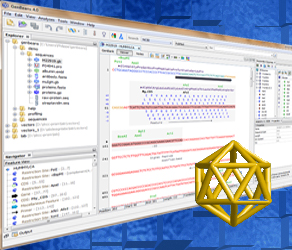 Try GenBeans: Best free software for DNA sequence editing!
FEEDBACK
Your comments & your suggestionsare appreciated. Please, notify us for resources and tools that you would like to see on this bench!
