


ADVERTISEMENT
Homology Search & BLAST
Nucleotide sequence blast at the NCBI
NCBI BLAST at the EMBL.The emphasis of this tool is to find regions of sequence similarity, which will yield functional and evolutionary clues about the structure and function of your novel sequence. WU-BLAST 2.0 and NCBI BLAST2 are distinctly different software packages, although they have a common lineage for some portions of their code, so the two packages do their work differently and obtain different results and offer different features.
WU-BLAST stands for Washington University Basic Local Alignment Search Tool. The emphasis of this tool is to find regions of sequence similarity or homology quickly, with minimum loss of sensitivity.
Advanced WU-BLAST Search with post-processing at EMBL
Translated BLAST (TBLASTN) search translated nucleotide database using a protein query.
SEQUEROME is a web-based Sequence Profiling Tool developed by the Bioinformatics and Computational Biosciences Unit (BCBU) at the Georgetown University - http://bioinformatics.georgetown.edu. This tool provides a unique and useful functionality of profiling each of the BLAST results to enable the users to extract the maximum out sequence alignment reports.
Nucleotide Similarity Search
EBI services that provides sequence similarity search against nucleotide and protein databases using the FASTA programs. FASTA can be very specific when identifying long regions of low similarity especially for highly diverged sequences. Works also for full genomes. Software can be downloaded.
BLAST against DNA/protein collections mapped in, or associated with, plant genomes
At NCBI at NCBI
GeneWise compares a protein sequence to a genomic DNA sequence, allowing for introns and frameshifting errors.
Smith/Waterman type searches on Paracel's Fast Data Finder (FDF) at EMBnet-CH. The Smith-Waterman (S-W) search algorithm used by the FDF server is about 5% more sensitive towards divergent matches than the BLAST algorithm.
YASS is a similarity search tool of genomic (DNA/RNA) sequences in fasta or plain text format (it produces pairwise local alignments). This tool is currently developed and maintained by L. Noe and G. Kucherov of the LIFL Bioinfo / INRIA Futurs Sequoia group. Like most of heuristic DNA local alignment software (BLAST, FASTA, PATTERNHUNTER, BLASTZ ...) YASS uses seeds to detect potential similarity regions, and then tries to extend them to actual alignments. This genomic search tool enables to search more fuzzy repeats, as non-coding DNA/RNA. Another simple, but interesting feature is that you can specify the seeds used in the search step.
BLAT on DNA is designed to quickly find sequences of 95% and greater similarity of length 25 bases or more. It may miss more divergent or shorter sequence alignments. It will find perfect sequence matches of 25 bases, and sometimes find them down to 20 bases. BLAT on proteins finds sequences of 80% and greater similarity of length 20 amino acids or more. In practice DNA BLAT works well on primates, and protein blat on land vertebrates.
The Web Bench

The Web Bench
is the essential companion to the biologist, bringing informational resources and a collection of tools & calculators to facilitate work at the bench and analysis of biological data.
Check out the full online bench here
Check out the full online bench here
Sequence Analysis with GenBeans
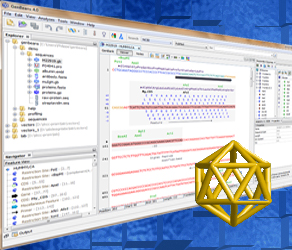 Try GenBeans: Best free software for DNA sequence editing!
FEEDBACK
Your comments & your suggestionsare appreciated. Please, notify us for resources and tools that you would like to see on this bench!
